Friday, December 14, 2012

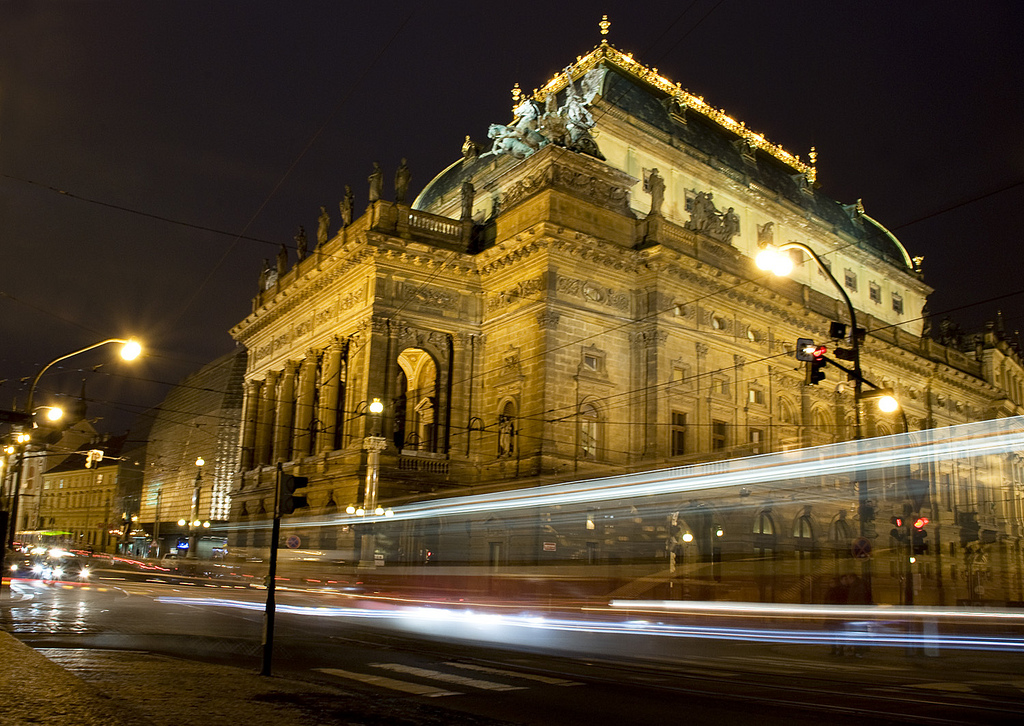
Prague National Theatre


Antonio Vivaldi


Antonio Lucio Vivaldi (4 March 1678 – 28 July 1741), nicknamed il Prete Rosso ("The Red Priest") because of his red hair, was an Italian Baroque composer, priest, and virtuoso violinist, born in Venice. Recognized as one of the greatest Baroque composers, his influence during his lifetime was widespread over Europe. Vivaldi is known mainly for composing instrumental concertos, especially for the violin, as well as sacred choral works and over forty operas. His best known work is a series of violin concertos known as The Four Seasons.
Many of his compositions were written for the female music ensemble of the Ospedale della Pietà, a home for abandoned children where Vivaldi had been employed from 1703 to 1715 and from 1723 to 1740. Vivaldi also had some success with stagings of his operas in Venice, Mantua and Vienna. After meeting the Emperor Charles VI, Vivaldi moved to Vienna, hoping for preferment. The Emperor died soon after Vivaldi's arrival.
Though Vivaldi's music was well received during his lifetime, it later declined in popularity until its vigorous revival in the first half of the 20th century. Today, Vivaldi ranks among the most popular and widely recorded of Baroque composers.

Beethoven and Romanticism


Beethoven's place as a transitional figure between the neo-classical period in the arts, called the "classical" period in music, and the Romantic period was a conscious intention of the many 19th century writers and composers, who pointed to his work as the radical departure from the past. As a result, a great deal of literature, including writing by ETA Hoffman, Robert Schumann, Richard Wagner and Gustav Mahler, placed his work at the pinnacle of what they were trying to achieve in music.

Because of his central importance, methods of conducting and playing, as well as music theory, were centered around his most important works, particularly his symphonies, concerti, string quartets, piano trios and sonatas for piano or piano and other instrument. Beginning from his pupil Carl Czerny and moving forward, basic terms such as tonality, sonata form and Allegro were defined or redefined in reference to his musical practice.
As importantly Beethoven's life was seen as the model for the "heroic artist", who cast his personal experiences, perceptions and biography into works, which would then be experienced by the audience members who would be transported to the emotional state of the artist, and thus participate in a "sublime" experience. That Beethoven had great difficulties in his life was joined to the sense of struggle and difficulty in his music, and used as the basis for an entire mythology of the role of the artist in society, and the difficulties of artistic creation. A biography by Anton Schindler was in accordance with this sense of Beethoven as Romantic, constantly putting direct emotional symbols into his work, such as saying "Thus Fate Knocks at the Door!" for the opening of the C Minor Symphony, number 5. Beethoven as icon can be seen in the efforts to erect amonument to him, led by Franz Liszt, and in the arguments over whether Johannes Brahms or Richard Wagner better represented the tradition of music that Beethoven was thought to have created.
With the 20th century a reaction against this "cult of the Romantic artist" began to be seen. In a sense it was a continuation of the Romantic cult in a different form: a new generation of artists wanted to claim Beethoven as their own, and place him in the context as the pinnacle figure of musical enlightenment and rationality. The emphasis on harmonic practice led to arguments that Beethoven was not "really" a romantic because of his general rejection of chromaticism in melodies, and his structural practices in preparing modulations. By the 1950s it was common to deny that Beethoven was a Romantic at all.
In the late 20th century, the pendulum began to swing back in the other direction, in some measure because of a revival of interest in Romanticism, and in part because of a change in the status of musical technique. With the falling out of favor of the idea that music was about "progress", the need to see Beethoven in technical terms diminished. The differences between his work and Mozart's became accentuated, in part because of the rise of neo-classical styles of playing or historically informed performance. Beethoven came to many to be seen in relation to contemporaries such as Goethe and Jacques-Louis David - having both neo-classical and Romantic elements to their work.

The Baroque era: The birth of German opera

The world's first opera was Dafne by Jacopo Peri, which appeared in Florence in 1598. Three decades later Heinrich Schütz set the same libretto in a translation by the poet Martin Opitz, thus creating the first ever German-language opera. The music to Schütz's Dafne is now lost and details of the performance are sketchy, but it is known to have been written to celebrate the marriage of Landgrave Georg II of Hessen-Darmstadt to Princess Sophia Eleonora of Saxony in Torgau in 1627. As in Italy, the first patrons of opera in Germany and Austria were royalty and the nobility, and they tended to favour composers and singers from south of the Alps. Antonio Cesti was particularly successful, providing the huge operatic extravaganza Il pomo d'oro for the imperial court in Vienna in 1668. Opera in Italian would continue to exercise a considerable sway over German-speaking lands throughout the Baroque and Classical periods. Nevertheless, native forms were developing too. In Nuremberg in 1644, Sigmund Staden produced the "spiritual pastorale", Seelewig, which foreshadows the Singspiel, a genre of German-language opera in which arias alternate with spoken dialogue. Seelewig was a moral allegory inspired by the example of contemporary school dramas and is the first German opera whose 

Francesco Saverio Geminiani


Francesco Saverio Geminiani (5 December 1687 – 17 September 1762) was an Italian violinist, composer, and music theorist.

[edit]BiographyBorn at Lucca, he received lessons in music from Alessandro Scarlatti, and studied the violin under Carlo Ambrogio (Ambrosio) Lonati in Milan and afterwards under Arcangelo Corelli. From 1707 he took the place of his father in the Cappella Palatina of Lucca. From 1711, he led the opera orchestra at Naples, as Leader of the Opera Orchestra and concertmaster, which gave him many opportunities for contact with Alessandro Scarlatti. After a brief return to Lucca, in 1714, he set off for London, where he arrived with the reputation of a virtuoso violinist, and soon attracted attention and patrons, including William Capel, 3rd Earl of Essex, who remained a consistent patron. In 1715 Geminiani played his violin concerti for the court of George I, with Handel at the keyboard.

Geminiani made a living by teaching and writing music, and tried to keep pace with his passion for collecting by dealing in art, not always successfully. Many of his students went on to have successful careers, such as:Charles Avison, Matthew Dubourg, Michael Christian Festing, Bernhard Joachim Hagen, and Cecilia Young.

After visiting Paris and residing there for some time, he returned to England in 1755. In 1761, on one of his sojourns in Dublin, a servant robbed him of a musical manuscript on which he had bestowed much time and labour. His vexation at this loss is said to have hastened his death.
He appears to have been a first-rate violinist. His Italian pupils reportedly called him Il Furibondo, the Madman, because of his expressive rhythms. He is best known for three sets of concerti grossi, his Opus 2 (1732), Opus 3 (1733) and Opus 7 (1746), (there are 42 concerti in all) which introduce the viola as a member of theconcertino group of soloists, making them essentially concerti for string quartet. These works are deeplycontrapuntal to please a London audience still in love with Corelli, compared to the galant work that was fashionable on the Continent at the time of their composition. Geminiani also reworked a group of violin sonatas from his teacher Corelli into concerti grossi.
His Art of Playing the Violin, published in London (1751), is the best-known summation of the 18th century Italian method of violin playing, and is an invaluable source for the study of late Baroque performance practice, giving detailed information on vibrato, trills, and other violin techniques. His Guida harmonica (c. 1752, with an addendum in 1756) is one of the most unusual harmony treatises of the late Baroque, serving as a sort of encyclopedia of basso continuo patterns and realizations. There are 2,236 patterns in all, and at the end of each pattern is a page number reference for a potential next pattern; thus a student composer studying the book would have an idea of all the subsequent possibilities available after any given short bass line.
Geminiani published a number of solos for the violin, three sets of violin concerti, twelve violin trios, The Art of Accompaniment on the Harpsichord, Organ, etc. (1754), Lessons for the Harpsichord, Art of Playing the Guitar(1760) and some other works.